
Independence Agreement, King’s House, 5 August 1957
Independence Agreement, King’s House, 5 August 1957

This photograph captures the signing of the Federation of Malaya Independence Agreement at King’s House (now Seri Negara). The nine Malay Rulers are seated at a single table with the British High Commissioner, representing a negotiated transfer of sovereignty.
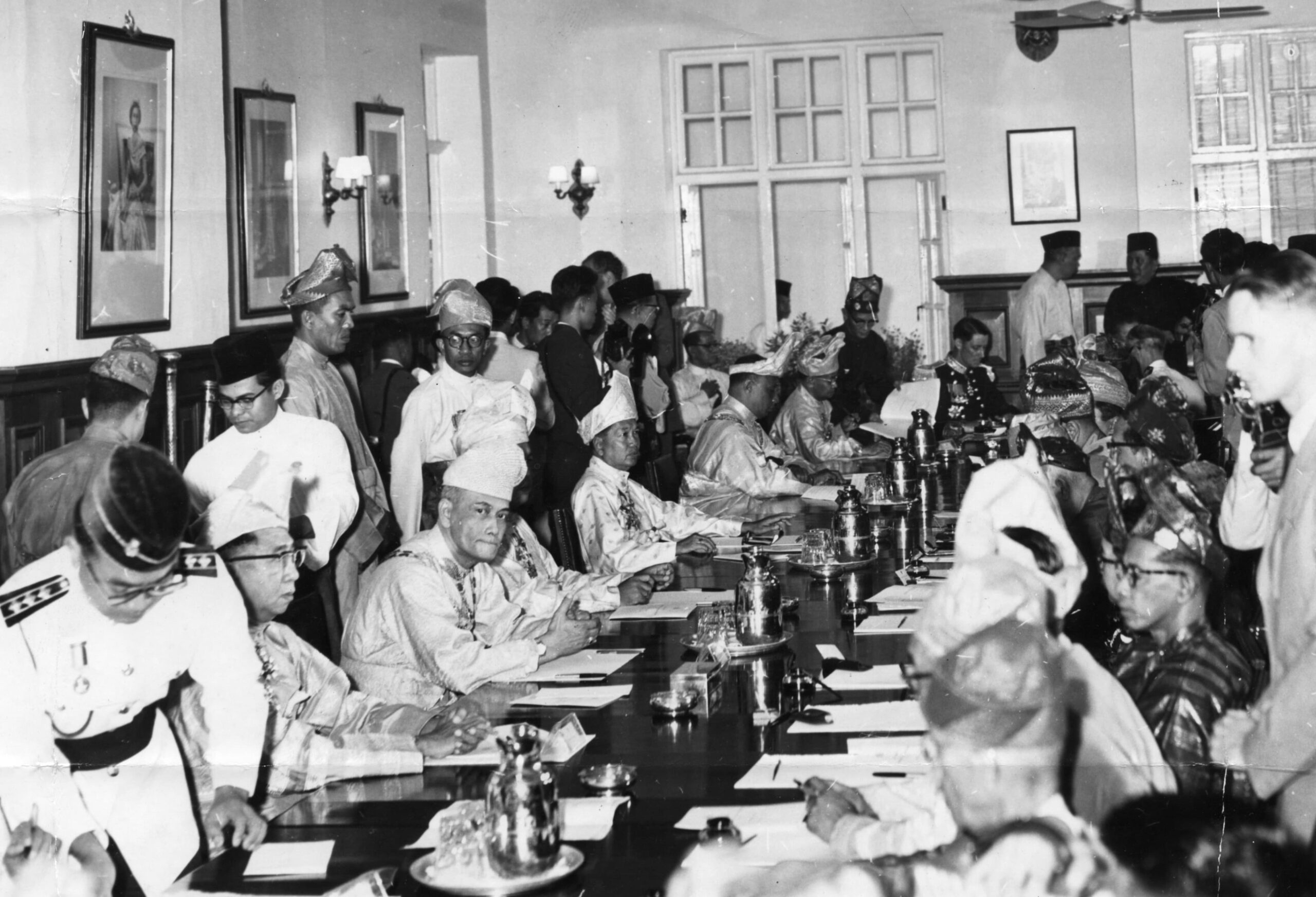
Seating Mapping (Left to Right)
Left side of table towards centre
- HRH Sultan Ismail Nasiruddin Shah Ibni Al-Marhum Sultan Zainal Abidin, Sultan of Terengganu
- HRH Sultan Ibrahim Ibni Al-Marhum Sultan Muhammad IV, Sultan of Kelantan
- HRH Tuanku Syed Putra Ibni Al-Marhum Syed Hassan Jamalullail, King of Perlis
- HRH Sultan Hisamuddin Alam Shah Ibni Al-Marhum Sultan Ala’eddin Suleiman Shah, Sultan of Selangor
- HRH Sultan Abu Bakar Ri’ayatuddin Al-Mu’adzam Shah Ibni Al-Marhum Sultan Abdullah, Sultan of Pahang
- HRH Tuanku Abdul Rahman Ibni Al-Marhum Tuanku Muhammad, Yang di-Pertuan Besar Negeri Sembilan
- Sir Donald MacGillivray (British High Commissioner to Malaya)
Also present but not visible in the photo:
Tunku Ismail Ibni Sultan Sir Ibrahim Al-Masyur (Crown Prince of Johor, representative of His Majesty the Sultan of Johor)
HRH Sultan Yussuf Izzuddin Shah Ibni Al-Marhum Sultan Abdul Jalil Shah, Sultan of Perak
HRH Sultan Sir Badlishah Ibni Al-Marhum Sultan Abdul Hamid Halim Shah, Sultan of Kedah


Grand Staircase
During the 1989 conversion of this building into a heritage boutique hotel, Seri Negara’s grand timber staircase was reconstructed to accommodate the new hotel layout. One of the key conservation achievements was the reinstatement of the staircase’s original orientation guided by archival research and early floor plans. The grand staircase now stands restored in locally sourced Merbau timber.
Porte Cochere Steps
Over the years, the lower steps at the Porte Cochere entrance had gradually been buried beneath raised road levels,obscuring the originalproportions. The profile of the steps was also altered and overlaid with new layers of mosaic and ceramic tiles. The restoration uncovered these steps and refurbished them to their original profile, revealing their authentic form once more.
Demolition of New Extensions
As part of the conservation works, physical extensions introduced over the years were carefully dismantled. The removal of these internal and external additions was essential to returning the building to its original massing and architectural integrity.
Reinstatement of Transom Windows
Old photographs and historical drawings provided vital evidence for restoring several framed transom windows to their original design.Louvered windows were replaced in accordance with authentic details, while corniceswere reconstructed based on the 1924 architectural drawings.
Building Materials Restoration
The timber flooringand supporting joists were restored using solid Merbau hardwood, while roof trusses and tiles were renewed to match the original materialsas closely as possible. The roof reinstatement included Marseille tiles, consistent with the building’s early fabric.
About the Heritage Buildings
Models on Display
Bangunan Sultan Abdul Samad (1897)
Completed in 1897, Bangunan Sultan Abdul Samad was designed by A.C. Norman with R.A.J. Bidwell and A.B. Hubback in the distinctive interpretation of British Raj architecture style. The construction cost was $152,000 Straits Dollars.
Built as the New Government Offices, it served as the Selangor State Secretariat and the Federal Secretariat for 77 years until 1974.
Its most recognisable feature is the 41.2-metre clock tower overlooking the Padang, which became a civic landmark of Kuala Lumpur. The building witnessed many defining national moments, including celebrations surrounding Malaya’s independence in 1957. Today, it remains one of the most iconic historic buildings in Malaysia and a central symbol of Kuala Lumpur’s colonial and post-independence history.

Carcosa (1898)
Carcosa was designed in 1897 and completed in 1898 as the official residence of the Resident-General of the Federated Malay States, first occupied by Sir Frank Swettenham.
Built by Messrs. Nicholas Walsh & Co., the project cost about $62,376 Straits Dollars for the residence and $69,000 for associated works including roads, stables and water supply.
Officially opened on 29 August 1898, Carcosa hosted receptions, grand balls and government functions.
Municipal/ Sanitary Board Offices and Town Hall (1904)
The Municipal/ Sanitary Board Offices and Town Hall were designed by Arthur Benison Hubback in 1901 while serving as Acting Architect of the Federal Public Works Department and a member of the Kuala Lumpur Sanitary Board. Completed in 1904 at a cost of $100,000 Straits Dollars, the building combined administrative and civic functions within a single complex. Architecturally, it reflects an eclectic Mughal style, distinguished by its curved façade and copper dome above the main porch.
Historically, the building had two separate entrances: the Sanitary Board Office on the upper floor, which served as the administrative centre for Kuala Lumpur’s early municipal governance, and the Town Hall on the ground floor, a venue for public gatherings, dances and social events. The Sanitary Board was locally known among Malays as “Santaribut”. Today the building is known as Panggung Bandaraya Kuala Lumpur and was gazetted as a National Heritage building in 2007.
Kuala Lumpur Old General Post Office (1907)
The Kuala Lumpur Old General Post Office was designed in 1902 and was completed in 1907 at a cost of $100,000 Straits Dollars. The construction contract was initially awarded to Towkay Choo Teck Lim and later taken over by Messrs. Walter Pallister of Singapore in 1904.
Located at the junction of Jalan Raja and Market Street, it became Kuala Lumpur’s third major post office since 1893. Architecturally, the building is notable as the city’s only eclectic Mughal-style structure without domes, featuring decorative pediments, chhatri pinnacles, and polygonal stair towers.
Seri Negara (1913)
Seri Negara was built near Carcosa as a smaller residence for the High Commissioner of the Federated Malay States, who was also the Governor of the Straits Settlements based in Singapore until the outbreak of World War Two. The proposal for the house was first mentioned in a dispatch by Sir John Anderson in 1910, suggesting a secondary residence adjacent to Carcosa for senior colonial officials.
The two-storey building originally featured seven bedrooms, each with a private verandah and bathroom. A separate office building, now known as Serai House, was connected to the main residence by a covered walkway. Over time, the building evolved in function and name — from Federal Lodge, Government House to King’s House, Istana Tetamu, and later Seri Negara, serving as a residence for visiting dignitaries and key constitutional figures of Malaysia.
Old Supreme Court (1915)
The Old Supreme Court Kuala Lumpur was designed in 1912 and was completed in 1915 at a cost of $208,500 Straits Dollars. Built by contractor Towkay Ang Seng, the courthouse stands on Jalan Raja beside the Gombak River, on the former site of Dhobby Green.
Officially opened on 1 May 1915 by High Commissioner Sir Arthur Young, it replaced the earlier court on Court Hill. Designed in an eclectic Mughal style, the building features corner towers crowned with decorative cupolas, a central courtyard and double arcades. Originally used as a courthouse, the building is now known as the Old High Court and was gazetted as a National Heritage building in 2012.
Model-model bangunan yang tidak dipamerkan
Federated Malay States Survey Office, Kuala Lumpur (1911)
The construction of the Federated Malay States (FMS) Survey Office began in August 1909 and was opened in 1911, with a construction cost of $150,000 Straits Dollars.
Built on the former yard of the Sanitary Board along Java Street, it served as the official headquarters of the FMS Survey Department. The Trigonometrical Branch, previously based in Taiping, relocated to the new offices in 1910.
Designed in an eclectic Mughal style, the building features a long façade with elegant loggia and clover-arched colonnades. Today known as the Old Survey Office, it was gazetted as a National Heritage building in 2012.
National Textile Museum (Federated Malay States Railways Central Office) (1905)
On 21 January 1948, the Dining Room of King’s House bore witness to a historic moment that would reshape the destiny of a nation. A total of 32 copies of the Federation of Malaya Agreement were signed — 16 in Malay and 16 in English. From these pages emerged the Federation of Malaya, bringing together 11 states — nine Malay States and the two Straits Settlements of Penang and Malacca.
Coming into force on 1 February 1948, it not only dissolved the Malayan Union but also stood as a symbol of the triumph of a people who rose to defend their dignity and sovereignty. From this moment began the foundations of a nation, laying the cornerstone for the modern constitutional system of Malaya, and ultimately Malaysia as we know it today.
The Malay Rulers who were the signatories to the Agreement were:
- HRH Sultan Sir Ibrahim Al-Masyhur ibni Sultan Sir Abu Bakar Al-Khalil Ibrahim Shah, Sultan of Johor
- HRH Sultan Sir Abu Bakar Ri’ayatu-din Al-Muazzam Shah Ibni Al-Marhum Sultan Sir Abdullah Al-mu’tassim Bi’llah Shah, Sultan of Pahang
- Negeri Sembilan:
HRH Tuanku Abdul Rahman Ibni Al-Marhum Tuanku Muhammad, Yang di-Pertuan Besar of Negeri Sembilan- Dato’ Klana Petra Muhammad Kassim bin Dato’ Andulika Mandalika Haji Abdul Rashid, YTM Undang Luak Sungei Ujong
- Dato’ Mendika Menteri Akhirulzaman Shahmaruddin bin Abdul Rahman, YTM Undang Luak Jelebu
- Dato’ Johan Pahlawan Lela Perkasa Sitiawan Abdul Manap bin Tolok, YTM Undang Luak Johol
- Dato’ Lela Maharaja Haji Ipap bin Abdullah, YTM Undang Luak Rembau
- Tunku Syed Idrus bin Tunku Syed Muhammad al-Qadri, YTM Tunku Besar Tampin
- HRH Sultan Hisamuddin Alam Shah Ibni Al-Marhum Sultan Ala’eddin Sulaiman Shah, Sultan Selangor
- HRH Paduka Seri Sultan Abdul Aziz al-Mu’tasim Billah Shah Raja Abdul Aziz, Sultan Perak
- His Majesty Sultan Sir Badlishah Ibni Al-Marhum Sultan Sir Abdul Hamid Halim Shah, Sultan Kedah
- HRH Tuanku Syed Putra Jamalullail Ibni Al-Marhum Syed Hassan Jamalullail, Raja Perlis
- HRH Sultan Sir Ibrahim Ibni Al-Marhum Sultan Muhammad VI, Sultan Kelantan
- HRH Sultan Ismail Nasiruddin Ibni Al-Marhum Sultan Zainal Abidin, Sultan Terengganu
The British High Commissioner who was also the Governor of the Malayan Union signed on behalf of King George VI whose authority extended over Penang and Malacca.
All signatories executed the agreement at King’s House except for His Royal Highness Sultan Sir Ibrahim Al-Masyhur ibni Sultan Sir Abu Bakar Al-Khalil Ibrahim Shah, the Sultan of Johor, who signed in Johor as he could not travel to Kuala Lumpur due to illness.
Also present to witness this historic moment were prominent Malay leaders who played key roles in the negotiations. Among them was Dato’ Onn Jaafar, the chief negotiator, who was also the President of UMNO at the time.

Among those present were senior officials of the Federation and British administration, royal aides, and members of the press, bearing witness to this historic transfer of sovereignty.

