
Federation of Malaya Agreement 1948

The Federation of Malaya Agreement 1948 Signed at King’s House, Kuala Lumpur.
On 21 January 1948, the Dining Room of King’s House bore witness to a historic moment that would reshape the destiny of a nation. A total of 32 copies of the Federation of Malaya Agreement were signed — 16 in Malay and 16 in English. From these pages emerged the Federation of Malaya, bringing together 11 states — nine Malay States and the two Straits Settlements of Penang and Malacca.
Coming into force on 1 February 1948, it not only dissolved the Malayan Union but also stood as a symbol of the triumph of a people who rose to defend their dignity and sovereignty. From this moment began the foundations of a nation, laying the cornerstone for the modern constitutional system of Malaya, and ultimately Malaysia as we know it today.
The Malay Rulers who were the signatories to the Agreement were:
- HRH Sultan Sir Ibrahim Al-Masyhur ibni Sultan Sir Abu Bakar Al-Khalil Ibrahim Shah, Sultan of Johor
- HRH Sultan Sir Abu Bakar Ri’ayatu-din Al-Muazzam Shah Ibni Al-Marhum Sultan Sir Abdullah Al-mu’tassim Bi’llah Shah, Sultan of Pahang
- Negeri Sembilan:
HRH Tuanku Abdul Rahman Ibni Al-Marhum Tuanku Muhammad, Yang di-Pertuan Besar of Negeri Sembilan- Dato’ Klana Petra Muhammad Kassim bin Dato’ Andulika Mandalika Haji Abdul Rashid, YTM Undang Luak Sungei Ujong
- Dato’ Mendika Menteri Akhirulzaman Shahmaruddin bin Abdul Rahman, YTM Undang Luak Jelebu
- Dato’ Johan Pahlawan Lela Perkasa Sitiawan Abdul Manap bin Tolok, YTM Undang Luak Johol
- Dato’ Lela Maharaja Haji Ipap bin Abdullah, YTM Undang Luak Rembau
- Tunku Syed Idrus bin Tunku Syed Muhammad al-Qadri, YTM Tunku Besar Tampin
- HRH Sultan Hisamuddin Alam Shah Ibni Al-Marhum Sultan Ala’eddin Sulaiman Shah, Sultan Selangor
- HRH Paduka Seri Sultan Abdul Aziz al-Mu’tasim Billah Shah Raja Abdul Aziz, Sultan Perak
- His Majesty Sultan Sir Badlishah Ibni Al-Marhum Sultan Sir Abdul Hamid Halim Shah, Sultan Kedah
- HRH Tuanku Syed Putra Jamalullail Ibni Al-Marhum Syed Hassan Jamalullail, Raja Perlis
- HRH Sultan Sir Ibrahim Ibni Al-Marhum Sultan Muhammad VI, Sultan Kelantan
- HRH Sultan Ismail Nasiruddin Ibni Al-Marhum Sultan Zainal Abidin, Sultan Terengganu
The British High Commissioner who was also the Governor of the Malayan Union signed on behalf of King George VI whose authority extended over Penang and Malacca.
All signatories executed the agreement at King’s House except for His Royal Highness Sultan Sir Ibrahim Al-Masyhur ibni Sultan Sir Abu Bakar Al-Khalil Ibrahim Shah, the Sultan of Johor, who signed in Johor as he could not travel to Kuala Lumpur due to illness.
Also present to witness this historic moment were prominent Malay leaders who played key roles in the negotiations. Among them was Dato’ Onn Jaafar, the chief negotiator, who was also the President of UMNO at the time.



On 15 December 2025, Prime Minister Dato’ Seri Anwar bin Ibrahim signed a commemorative plaque marking the historic completion of the restoration of Seri Negara. The ceremony signified the return of this landmark building to the public following an extensive conservation effort led by Khazanah Nasional Berhad under Dana Warisan and Warisan KL.
In his address, the Prime Minister emphasised that the preservation of heritage is not merely an exercise in revisiting history, but an act of giving meaning to independence and national identity. He reminded the audience that freedom was never attained without sacrifice, noting that the nation’s story is marked by hardship and struggle — by sweat, blood and tears — and that younger generations must understand this inheritance.
Reflecting on the building’s past as a symbol of colonial elitism, he underscored that Seri Negara now carries renewed significance. No longer an exclusive enclave, it has been redefined as a space belonging to all. Within the framework of Malaysia MADANI, he stressed the principle of inclusivity, affirming that schoolchildren, young people and ordinary citizens must be able to claim this place as their own — as citizens of a sovereign and independent nation.
He further described the restoration as an endeavour to be enjoyed and embraced by all Malaysians, one in which they may take pride as an expression of the true meaning of independence.
This commemorative plaque therefore signifies more than a formal inauguration. It marks a profound shift in meaning — from a monument of colonial authority to a living, inclusive heritage landmark. It records the moment Seri Negara was reclaimed as a public cultural space, a platform for historical learning, and a symbol of national pride for present and future generations.
Grand Staircase
During the 1989 conversion of this building into a heritage boutique hotel, Seri Negara’s grand timber staircase was reconstructed to accommodate the new hotel layout. One of the key conservation achievements was the reinstatement of the staircase’s original orientation guided by archival research and early floor plans. The grand staircase now stands restored in locally sourced Merbau timber.
Porte Cochere Steps
Over the years, the lower steps at the Porte Cochere entrance had gradually been buried beneath raised road levels,obscuring the originalproportions. The profile of the steps was also altered and overlaid with new layers of mosaic and ceramic tiles. The restoration uncovered these steps and refurbished them to their original profile, revealing their authentic form once more.
Demolition of New Extensions
As part of the conservation works, physical extensions introduced over the years were carefully dismantled. The removal of these internal and external additions was essential to returning the building to its original massing and architectural integrity.
Reinstatement of Transom Windows
Old photographs and historical drawings provided vital evidence for restoring several framed transom windows to their original design.Louvered windows were replaced in accordance with authentic details, while corniceswere reconstructed based on the 1924 architectural drawings.
Building Materials Restoration
The timber flooringand supporting joists were restored using solid Merbau hardwood, while roof trusses and tiles were renewed to match the original materialsas closely as possible. The roof reinstatement included Marseille tiles, consistent with the building’s early fabric.
List of Names
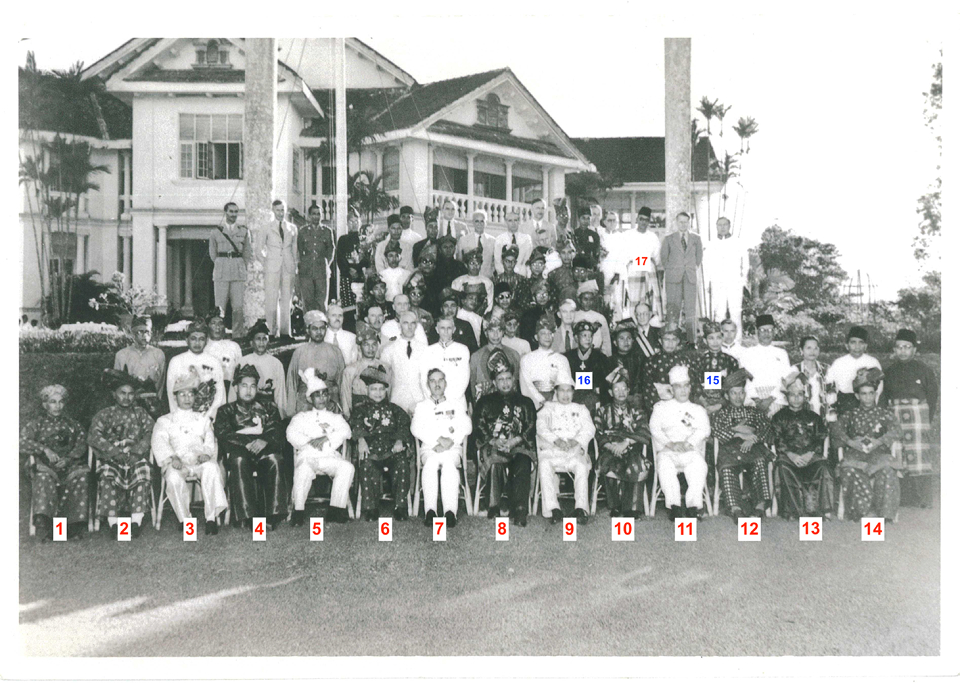
Disclaimer:
The list of names identifies the Malay Rulers and the British representative seated in the front row. Other individuals in the photograph include Chief Ministers, representatives of the Malay Rulers, the United Malays National Organisation (UMNO) representatives, British officers, and legal advisers. If you recognise anyone not listed, please notify the gallery staff. Thank you.
First row, seated from left:
- Dato’ Lela Maharaja Haji Ipap bin Abdullah, YTM Undang Luak Rembau
- Dato’ Mendika Menteri Akhirulzaman Shahmaruddin bin Abdul Rahman, YTM Undang Luak Jelebu
- HRH Sultan Ismail Nasiruddin Ibni Al-Marhum Sultan Zainal Abidin (Negeri Sembilan)
- HRH Tuanku Syed Putra Jamalullail Ibni Al-Marhum Syed Hassan Jamalullail (Perlis)
- HRH Sultan Abdul Aziz al-Mu’tasim Billah Shah Raja Abdul Aziz (Perak)
- HRH Tuanku Abdul Rahman Ibni Al-Marhum Tuanku Muhammad (Yang-di-Pertuan Besar Negeri Sembilan)
- Sir Edward James Gent (Governor of the Malayan Union)
- HRH Sultan Sir Abu Bakar Ri’ayatu-din Al-Muazzam Shah Ibni Al-Marhum Sultan Sir Abdullah Al-mu’tassim Bi’llah Shah (Pahang)
- HRH Sultan Hisamuddin Alam Shah Ibni Al-Marhum Sultan Ala’eddin Sulaiman Shah (Selangor)
- HRH Sultan Sir Badlishah Ibni Al-Marhum Sultan Sir Abdul Hamid Halim Shah (Kedah)
- HRH Sultan Sir Ibrahim Ibni Al-Marhum Sultan Muhammad VI (Kelantan)
- Dato’ Klana Petra Muhammad Kassim bin Dato’ Andulika Mandalika Haji Abdul Rashid, YTM Undang Luak Sungai Ujong
- Dato’ Johan Pahlawan Lela Perkasa Sitiawan Abdul Manap bin Tolok, YTM Undang Luak Johol
- Tunku Syed Idrus bin Tunku Syed Muhammad al-Qadri, YTM Tunku Besar Tampin
Second row, fifth from right:
- Tan Sri Dato’ Sri Setia Raja Dato’ Haji Nik Ahmad Kamil bin Nik Mahmud (Dato’ Seri Setia Raja Kelantan)
Second row, eighth from right:
- Dato’ Sir Mohamad Sheriff Osman (Kedah Government Secretary)
Last row, third from right:
- Dato’ Onn Jaafar (Menteri Besar Johor, Presiden UMNO)
Working Committee
The Working Committee, established on 25 July 1946 to discuss the framework of the Federation of Malaya Agreement 1948, consisted of:
Menteri Besar (MB)
The position of Menteri Besar in Malaya was formally established on 1 February 1948, following the formation of the Federation of Malaya, which replaced the Malayan Union, with Johor becoming the first state to implement the post. They served as the chief executive of the state under British administration, and after independence in 1957, the position was typically held by the leader of the majority party in the state government.
Tan Sri Dato’ Sri Setia Raja Dato’ Haji Nik Ahmad Kamil bin Nik Mahmud (MB Kelantan)Dato’ Sir Mohamad Sheriff Osman (MB Kedah)
Datuk Hamzah Abdullah (Orang kaya Menteri Besar Selangor
Tan Sri Dato’ Seri Haji Abdul Wahab bin Abdul Aziz (MB Perak)
Dato’ Setia Wangsa Haji Sir Mahmud bin Mat (MB Pahang)
Tun Dato’ Maha Kurnia Abdul Malek bin Yusuf (MB Negeri Sembilan)
Tengku Muda Datuk Haji Sir Muhammad ibni Sultan Haji Sir Ahmad al-Mu’azzam Shah (MB Terengganu)
- Dato’ Haji Raja Ahmad bin Raja Endut (MB Perlis)

Malay Rulers’ Representatives
- Raja Kamaralzaman Raja Ngah Mansur (Raja Kecil Tengah Perak)
UMNO Representatives
- Dato’ Onn Jaafar
- Dato’ Haji Abdul Rahman bin Mohamed Yassin
- Dato’ Megat Yunus bin Megat Mohd Isa
British Government Representatives
- Sir Alexander Theodore Newboult (Chief Secretary Malayan Union)
- Sir Kenneth Kennedy O’Connor (Attorney General Malayan Union)
- W.D. Godsall (Financial Secretary)
- Dr. W. Linehan – Malayan Civil Service (MCS)
- Williams – Malayan Civil Service (MCS)
- D.C Watherston (Secretary)
Legal Advisers
- Sir Theodore Samuel Adams (Adviser to the Malay Rulers)
- Sir Roland St. John Braddell (Legal Adviser to UMNO)
- Major General Sir Herbert Ralph Hone (Observer and representative of the Governor General)
Related Link
Link to the “Hari Ini Dalam Sejarah” website regarding the formation of the Federation of Malaya 1948:
https://hids.arkib.gov.my/#/site_vod_detail/76?prc=shw

